Dancing workshop 16, 18 and 19 cent with Lieven Baert in Warsaw
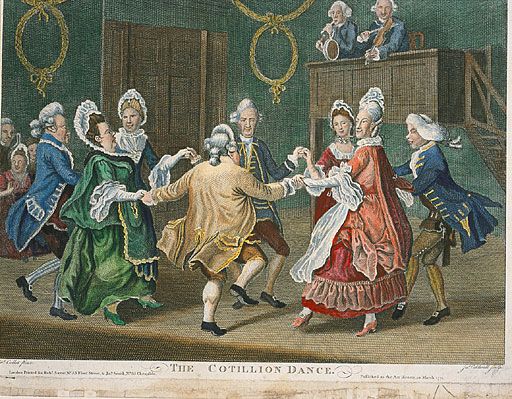
We ("Academy of Early Culture" Fundacy) kindly invite you to participate in early dance workshops with our favourite dancing master Lieven Baert in Warsaw, Poland – dances of 16th, 18th and 19th century Europe.
Level: intermediate
About teacher: https://earlydance.org/whois/1006-lieven-baert
Dates: 12-14th of April 2019
Schedule: 10.00-13.00, 14.30-17.30
13.00-14.30 lunch breake
17.30-18.00 time to recording, talking etc
Details:
The 16th century style dances - 12th of April (Friday)
dance for 3 dancers, theatrical choreography “Foil Se l'Aura Spira fo 3”
The 18th century style dances - 13th of April (Saturday)
“Entree de deux Baccante”, maybe Matelotte for couple (depends of time)??
The 19th century dances - 14th April (Sunday)
“Slovanka - Roccoco Quadrille” from Becker (circa 1820)
NOTE: Workshop language - English
Venue:
The dance workshop will take place in the center of Warsaw
Costs:
One workshop/one day: 48 EUR
payable before workshops
The number of places is limited!
The enrollment via email: kulturadawna@gmail.com
Infos needed:
- Names of participants
- Let us know witch day/style you choose.
There will be also some nice integrational event prepared for all participants.
If you have a questions or suggestions, please contact us:
Anna Ilczuk / kulturadawna@gmail.com
Event in English: https://www.facebook.com/events/338756526754417/
Polish event: https://www.facebook.com/events/550013068815206/?notif_t=plan_edited¬if_id=1552385404870199
- Workshop
- Renaissance
- Early Baroque
- 19th century
- Intermediates
Einfache Tänze der Renaissance
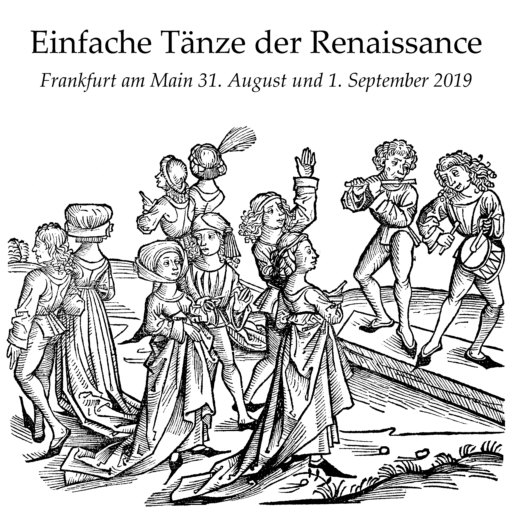
Domenico da Piacenza ist unser erster Held der Tanzgeschichte – er hat uns aus der Mitte des 15. Jahrhunderts ein erstes größeres Theorietraktat über den Tanz mit heute noch rekonstruierbaren Choreographien überliefert. Er und seine Schüler Antonio Cornazzano und Guglielmo Ebreo prägen so unseren Blick auf den Tanz im Italien der frühen Renaissance.
Ein weiterer Held der Tanzgeschichte ist Thoinot Arbeau (eigentlich: der Kleriker Jehan Tabourot), der in Frankreich Ende des 16. Jahrhunderts mit seinem Buch Orchésographie auf die Tänze seiner Jugend zurückblickt. Ihm verdanken wir den ersten Versuch einer verständlichen und an die Musik gekoppelten Tanznotation.
Dieses Wochenende richtet sich mit einer Handvoll vergnüglicher Tänze und einem übersichtlichen Schrittmaterial besonders an Anfänger, die sich auf eine kleine Zeitreise in das 15. und 16. Jahrhundert begeben möchten.
Die Zeiten sind:
Samstag 12:00-14:30 und 15:30-18:00 Uhr
Sonntag 10:00-12:30 und 13:30-16:00 Uhr
Historischer Tanz in Frankfurt 2019:
19.-20. Jan.: Das Menuett Wochenende
13.-14. Apr.: Alpenquadrillen von 1840
18.-19. Mai: Das Longway Wochenende
8.-10. Juni: „La Bourgogne“ (1700) (3-Tage Pfingstkurs)
31. Aug.-1. Sep.: Einfache Tänze der Renaissance
12.-13. Okt.: Das Cotillon Wochenende
9.-10. Nov.: Empire: Das Jane Austen Wochenende
7.-8. Dez.: „Entrée pour une Femme – Forlane“ (1704)
Weitere Informationen finden sich auf meiner Webseite www.historische-tanzkunst.de sowie im Flyer.
- Workshop
- Renaissance
- Quattrocento
- Beginner
Spectacle de danse et musique ancienne "Favola...balla" et Bal Renaissance
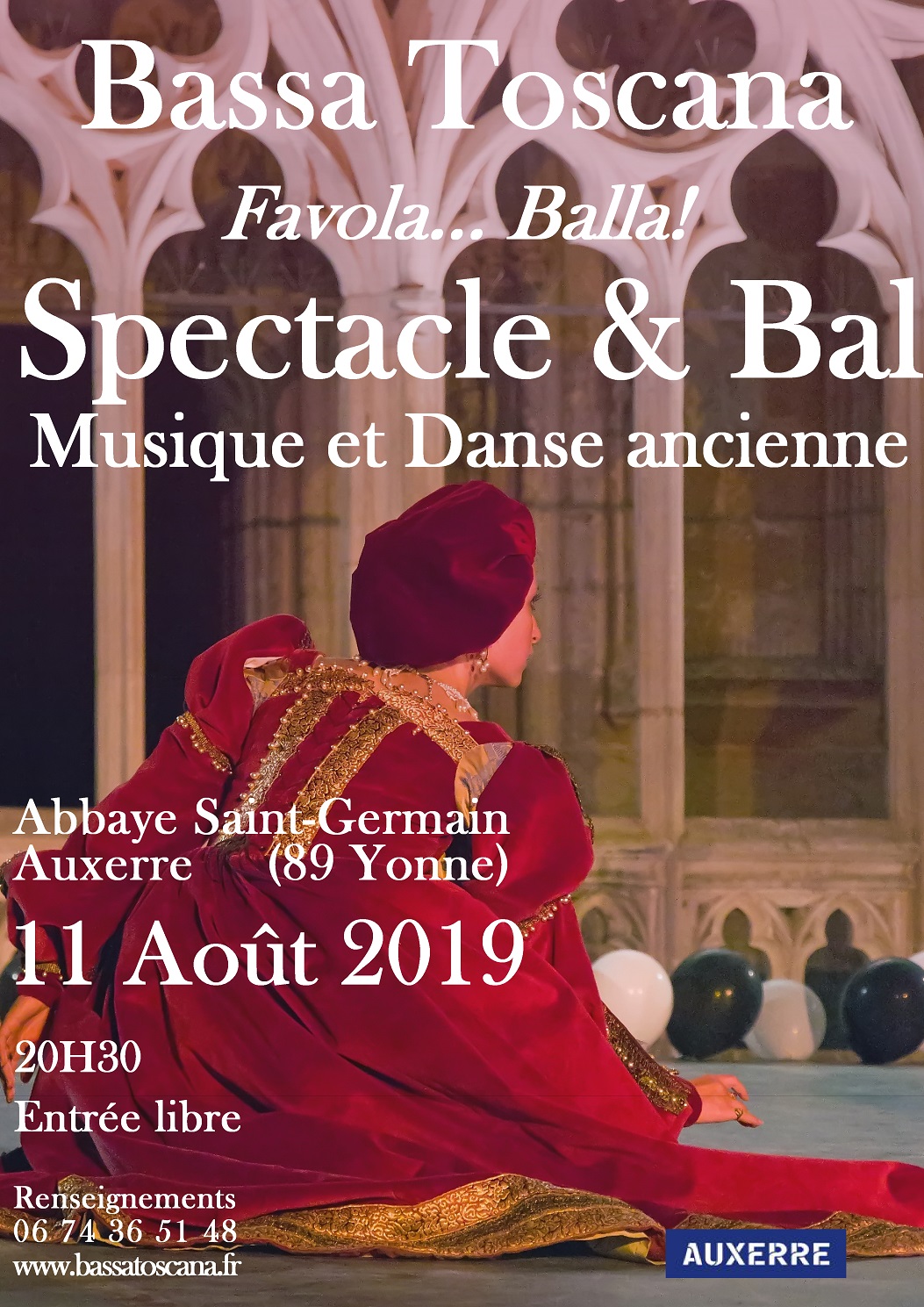
Les chorégraphies du spectacle « Favola… balla ! » seront une évocation vivante des fables d’Esope (VIIème siècle avant JC) traduites au XVIème siècle (Perret, Corrozet) et bien sûr de celles de Jean de La Fontaine.
La représentation animale, qu’elle soit humoristique ou plus sensible, accompagnera donc la fantaisie musicale et dansante du spectacle estival 2019, qui s’achèvera comme chaque année par un bal où le public sera chaleureusement invité.
Spectacle dans le Cloître de l'Abbaye à 20h30
Bal sur le Parvis à 22h00
ENTREE LIBRE
Les Artistes qui encadreront les stagiaires de la compagnie lors du spectacle du 11 août :
Renaissance Italienne
Bernadette Jacquet
Stéphane Quéant
Danse Baroque
Hubert Hazebroucq
Flûte et Tambour
Solène Riot
Viole de Gambe
Elisabeth Zehm-Thoma
Chanteur
Pablo Cherrey-Iturralde
- Performance
- Ball
- Renaissance
- Quattrocento
- Cinquecento
- French Renaissance
- Baroque
- Early Baroque
- Professionals
- All levels
5th Period Dances Summer School 2019
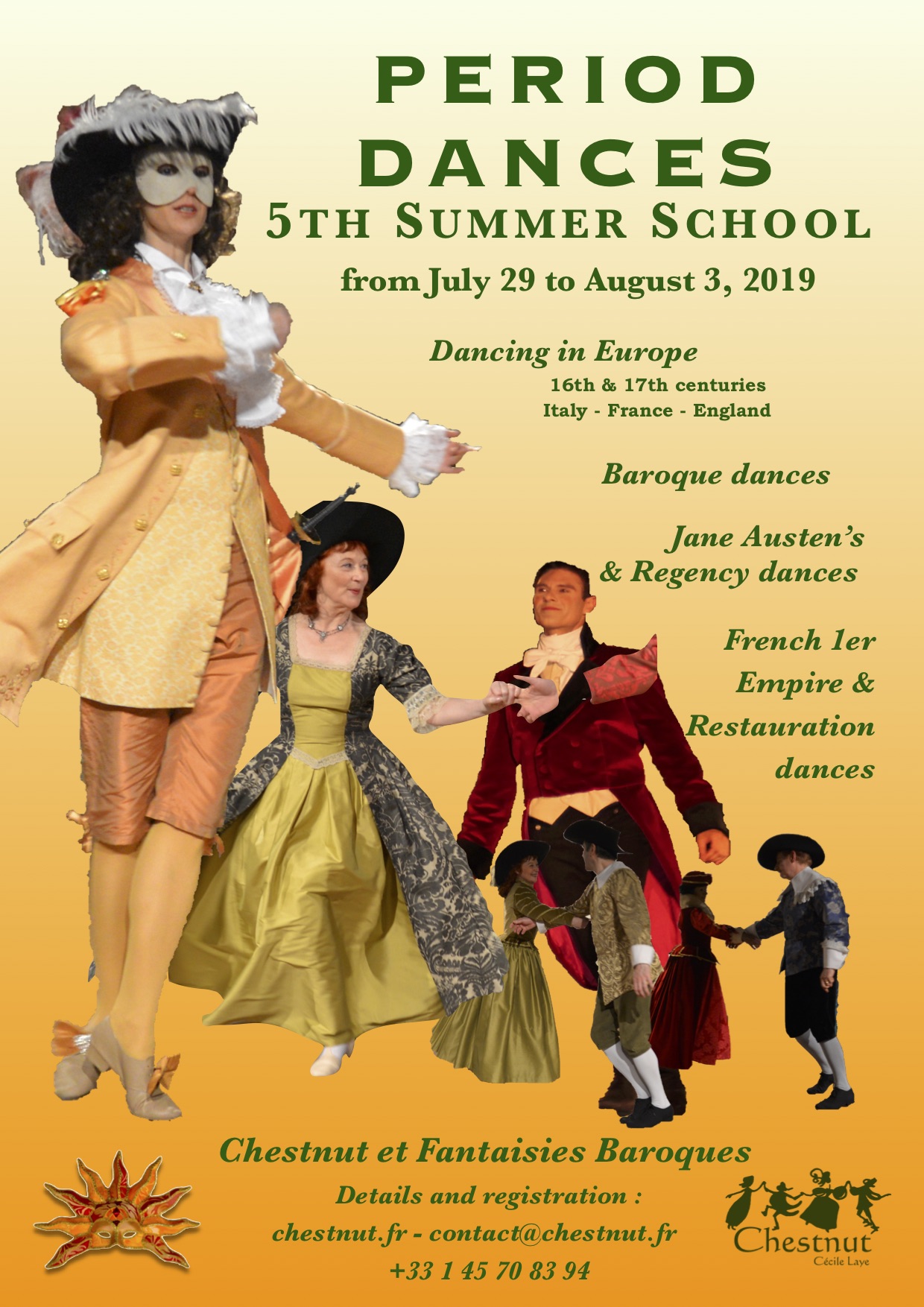


Chestnut and Fantaisies Baroques welcome you from July 29 to August 3, 2019 to their fifth summer school of period dances in Normandy.
CONTENTS
- Dancing in Europe in two, four or eight during the end of the 16th and the beginning of the 17th centuries (Italian, French and English tradition)
- Baroque dances
- Jane Austen & Regency dances
- French 1rst Empire - Restauration dances
With four different subjects and two instructors (Cécile Laye and Irène Feste), you’ll be able to make up your own schedule according to your tastes and how energetic you feel. You may opt for an intensive dance programme, up to 6 hours daily, or choose a mix of workshops and time for resting or for touring the area.
In our workshops, the programme allows for all levels of dancing. Each dancer will be taught variations suitable to his/her possibilities.Each day will start at 9 a.m. with a half hour of warming up exercises, led by each instructor in turn.
WORKSHOP DESCRIPTION
MORNING :
- Dancing in Europe in two, four and eight during the end of the 16th and the beginning of the 17th centuries through the Italian, French and English traditions workshop (3 hours : 9.45 am - 0.45 pm): Cécile Laye
- An Andréa Francalanci choreography for several couples on the Toccata of Monteverdi’s Orfeo
- La Battaglia: a ballet for two couples, written by Cesare Negri, « Milanese detto il Trombone», in 1602
- Two choreographies for 8 dancers out of Playford’s early editions: Hunsdon House and Nonsuch
or

- Baroque dances workshop (3 hours : 9.45 am - 0.45 pm): Irène Feste
La Czarienne par Monsieur Balon, out of the XVIth Recueil de danses dated 1718, collected and edited by Mr Dezais, a Dancing Master. It is a ballroom dance in two parts, one a 3-time piece, the other a rigaudon. Initiation à la notation Beauchamp-Feuillet
AFTERNOON :
- Jane Austen's and Regency dances workshop(1 hour and half : 3.00 pm - 4.30 pm or 5.00 pm - 6.30 pm on alternate days): Cécile Laye
In 1798 Jane Austen, then 23 years old, came home from a ball and wrote “The programme included twenty dances. I danced them all without feeling tired at all”. Based on Jane Austen’s books and letters, we’ll try and find out what she could have danced at the time:
- A cotillon en allemande (Longman 1781)
- A longways triple minor set (Frisky - Straight and Skillern 1775)
- A reel
- La Boulangère (Colinet 1815 and Campbell)
and/or
- French 1rst Empire - Restauration workshop (1 hour and half : 3.00 pm - 4.30 pm or 5.00 pm - 6.30 pm on alternate days): Irène Feste
An adaptation of la Cosaqueaccording to Michel Saint Léon’s « Cahiers d’exercices ». It is a character dance that came into fashion in balls around the 1830s. It calls for the elaborate technical vocabulary we still use but in our workshops we’ll adapt it, while respecting its style, in order to make the learning and dancing more pleasant.
EVENING ACTIVITIES
Evening entertaiment will be organized for trainees and instructors to share a good time:
- Tuesday: team quizz on period dances
- Wednesday: films
- Thursday: will be decided by trainees
- Friday : Costume Ball including the dances studied in the workshops. (Please note: costume is not a must.)
TEACHERS
[
Cécile LAYE
Cécile Laye studied historical dances in England with Dolmetsch Historical Dance Society, Nonsuch History and Dance and EFDSS (English folk Dance and Song Society). She studied in particular with famous teachers or researchers such as Anne Daye, Anne Cottis, Peggy Dixon, Ethyl Anderson, Marjorie Fennessy, Tom Cook and Alan Davies. In France, she studied under Francine Lancelot, Andréa Francalancci and Barbara Sparti. In 1998 she founded the CHESTNUT company to make available the repertoire of figure dances of the time of the Stuarts and the English inheritance, from a literary and historical point of view, in collaboration with musicians, dancers, actors, singers, horse riders and fencers. She also graduated from Cours Florent in acting and staging.

Irène FESTE
After a diploma in ballet dancing, Irène Feste studied « Belle Dance » with L’Eclat des Muses, a company led by Christine Bayle. In 2007, she founded her own company with Pierre-François Dollé: Fantaisies Baroques. They design and perform dance/theatre shows in schools and music schools. Irène Feste specialises in baroque and Premier Empire (Napoleonic time) dances, her two main fields of research. She regularly dances with compagnie Divertimenty.
VENUE
Le Tapis Vert, a residence for artists nestling in a large estate in the Normandie-Maine park, offers several accommodation possibilities on site, from boarding-house to rented rooms and camping. Also on site, two superb halls for activities and a circus tent make for a high quality environment.


FEES
Tuition prices (€/pers.) :
1 hour 30 Module: €125
- French 1rst Empire - Restauration (1h30 in the afternoon)
- Jane Austen & Regency dances (1h30 in the afternoon)
3 hours Module : €216
- Baroque dances (3 hours in the morning)
- Dancing in Europe 16th & 17th centuries (3 hours in the morning)
- French 1rst Empire - Restauration + Jane Austen & Regency dances (2 x 1h30 in the afternoon)
4 hours 30 Module : €288
- Baroque dances (3 hours in the morning) + French 1rst Empire - Restauration or Jane Austen & Regency dances (2 x 1h30 in the afternoon)
- Dancing in Europe 16th & 17th centuries (3 hours in the morning) + French 1rst Empire - Restauration or Jane Austen & Regency dances (2 x 1h30 in the afternoon)
6 hours Module: €336
- Baroque dances (3 hours in the morning) + French 1rst Empire - Restauration and Jane Austen & Regency dances (2 x 1h30 in the afternoon)
- Dancing in Europe 16th & 17th centuries (3 hours in the morning) + French 1rst Empire - Restauration and Jane Austen & Regency dances (2 x 1h30 in the afternoon)
Accommodation and meals prices (€/pers.) : available on our site and on registration form.
Please note : before you fill in your registration form, please check with us calling +33 660 222 321 or contacting us at contact@chestnut.fr to find out which type of accommodation is still available.Please note: there are no shops near Tapis Vert. It is a long way from any village.
- Bed sheets are included in the price
- Towels are not included. You have to bring them.
HOW TO GET THERE
Reaching Tapis Vert
- By car
Le Tapis vert is 200 km away from Paris and 130 km away from Rennes.
- By train
The nearest train station is Alençon, reached either through Surdon from Paris Montparnasse-Vaugirard or by TGV through Le Mans. Share taxi or car from Alençon station.
IMPORTANT if you come by train:
Le Tapis Vert is a half-hour drive away from the Alençon train station. Taxis are available. However, we try to coordinate dancers arriving by car so that they collect those arriving by train on their way. And we try and to the same on Saturday for departures.
If you arrive on Monday:
We’ll try and organise cars to fetch people arriving in Alençon on the 16:06 train and bring them to Tapis Vert. Please let us know if you chose that train, and if not, at what time you plan to get to Alençon.
Please note: we do our best to organise cars and bring train passengers from the Alençon station to Tapis Vert on Monday afternoon. However, if you arrive too late you may have to take a taxi.
Leaving on Saturday:
We’ll organise car sharing to Alençon railway station on Saturday morning for those taking the 12:48 train. Please let us know if you chose that train or if not, at what time you’ll be leaving.
Please note: we’ll do our best to organise car-sharing and drive train passengers to the Alençon station on Saturday morning. However, if you leave too early or are the only one from Tapis Vert taking a particular train you may have to take a taxi.
TRAINEES’ WELCOME
Trainees are welcome from 5:00 pm on Monday, July 29, 2019.
Please note : as no evening meal is provided on the first day evening (Monday), please bring a picnic dinner !
Departure on Saturday, August 3, 2019 after breakfast.
REGISTRATION
Please note : before you fill in your registration form, please check with us calling +33 660 222 321 or contacting us at contact@chestnut.fr to find out which type of accommodation is still available.
Registration form available here (if nothing is displayed, look in the downloads of your browser)
Payment from abroad by bank transfer or PayPal : please contact us +33 660 222 321 or contact@chestnut.fr
CONTACT- INFORMATION
contact@chestnut.fr or +33 660 222 321
FLYER :
- Workshop
- Summer School
- Renaissance
- Cinquecento
- French Renaissance
- Tudor
- Baroque
- Early Baroque
- Playford
- 19th century
- Quadrilles
- Regency
- Beginner
- Intermediates
- Advanced
KRAKOW DANCES WORKSHOPS during 20th CRACOVIA DANZA COURT DANCE FESTIVAL
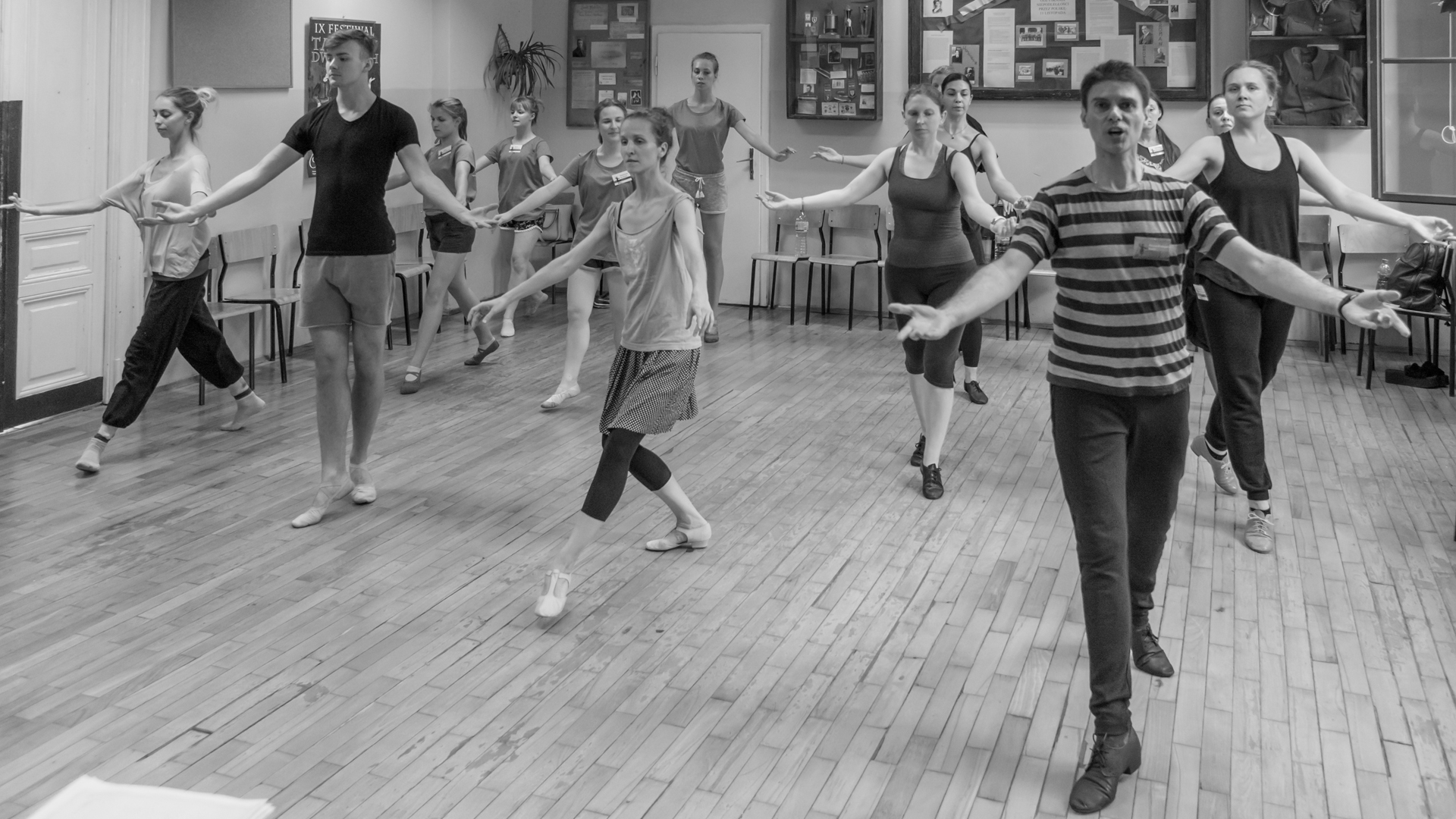
KrakOw DANCES WORKSHOPS
during
20th CRACOVIA DANZA COURT DANCE FESTIVAL
21-28 July 2019
The 20th anniversary of the Cracovia Danza Court Dance Festival will take place in Krakow between July 21-28. The tagline of this year’s Festival edition is Fables, Fairytales, and Legends, as the program of the event is based on the fantasy stories which relate to the European, Polish, and even Krakow cultural heritage.
Traditionally, the Festival will be accompanied by the Krakow Dances 5-day workshops, annually attended by over 150 participants from around the globe. The attendees are supervised by such dance champions as e.g. Alaknanda (India), Barbara Segal (England), Marie-Claire Bär Le Corre (France), Ana Yepes (Spain), and Pierre-Francois Dollé (France). For the first time this year, the Festival will host a special guest Irène Feste, a specialist in the ball dances of the first half of the 19th century, who will run a workshop on empire dances. Besides dance workshops there will be also courses of pantomime and historical fencing.
Workshops will take place in the centre of Krakow, in Bartłomiej Nowodworski High School. After 5-day workshops participants will present their new skills during final shows of workshop group on the stage in the Main Square.
REGISTRATION: http://cracoviadanza.pl/festiwal-en/aktualnosc/78
List of courses:
English baroque dance – Barbara Segal
French baroque dance – Pierre-Francois Dollé
French renaissance dance – Marie-Claire Bär Le Corre
Spanish dance – Ana Yepes
Italian renaissance dance
– Gloria Giordano (masterclass)
– Marta Baranowska (begginers group)
French contredanses – Pierre-Francois Dollé
Old Polish dance – Leszek Rembowski
Pre-romantic social dance – Irène Feste - NEW
Indian Kathak dance – Alaknanda
Pantomime – Krzysztof Antkowiak
Historical fencing – Mateusz Jabczanik
PARTICIPATION COSTS:
Regular price for one course: 290 PLN (€ 60)
DISCOUNT
200 PLN (€ 50)
Apply for:
1. those who sign up for the minimum of three courses
2. those who have participated in the workshops for at least three years
FISRT MINUTE DISCOUNT
Those, who sign up in advance will receive a 10% discount. The condition for receiving a discount is to send the application along with proof of payment of the advance before April 30th 2019.
WORKSHOP ORGANIZERS
Ardente Sole Foundation
Cracovia Danza Ballet
- Workshop
- Renaissance
- French Renaissance
- Tudor
- Baroque
- Spanish baroque
- 19th century
- mixed
- All levels
Bizzaria d’Amore. Italienische Tänze um 1600
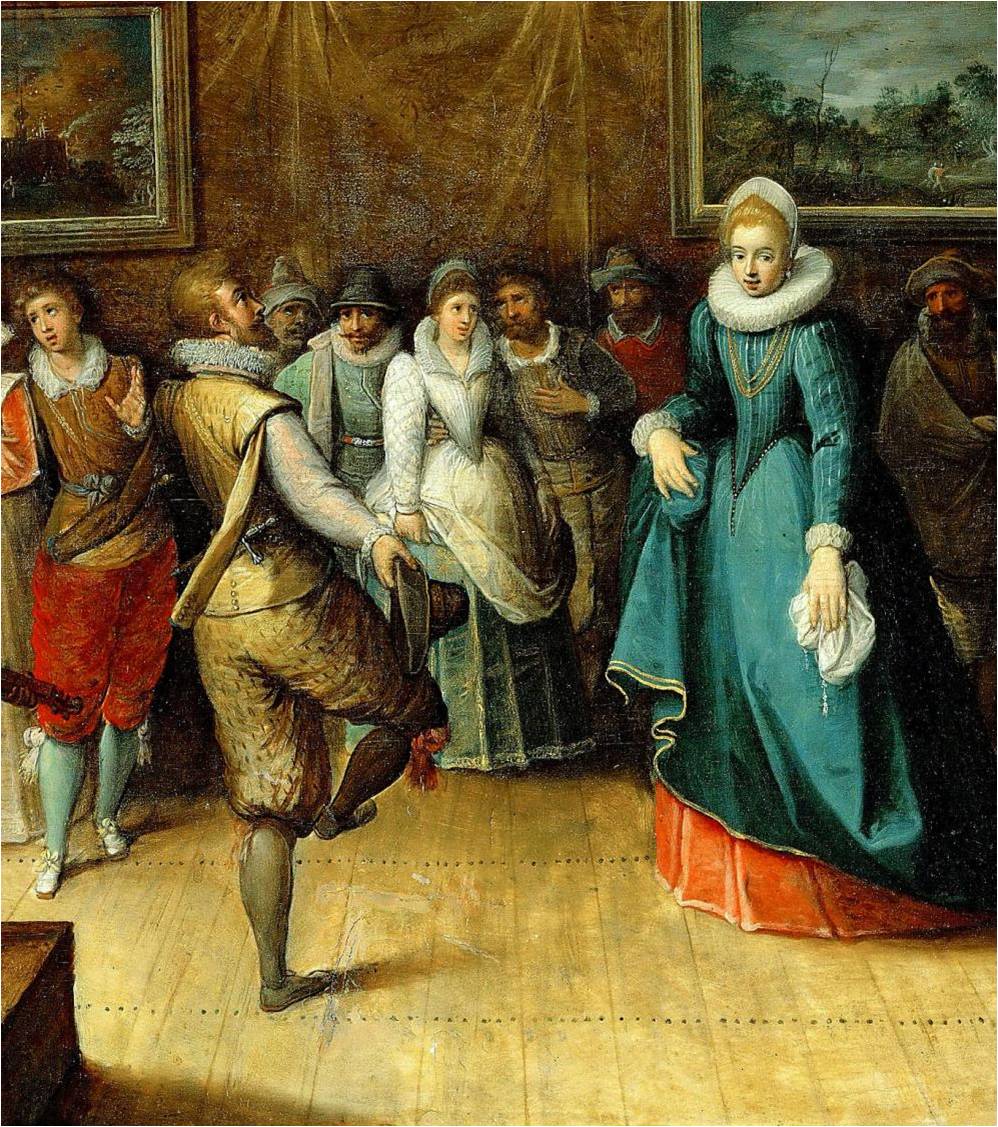
Bizzaria d’Amore. Italienische Tänze um 1600 mit Nicolle Klinkeberg. Auf den glanzvollen Bällen und Festen an den Höfen des 16. und frühen 17. Jahrhundert bot der Tanz wunderbare Gelegenheiten sich zu präsentieren und eine „schöne“ Figur zu machen. Dazu war es nicht genug die Tänze auswendig zu kennen und gegebenenfalls kunstvolle Improvisationen zeigen zu können. Reverenz, Handkuss und Hantieren mit Hut und Taschentuch mussten ebenso gelernt sein wie die Schritte. Wir werden uns in diesem Kurs einfachen Choreografien aus den Lehrbüchern der Tanzmeister Fabritio Caroso und Cesare Negri widmen. „Bizzaria d’Amore“ für zwei Paare steht auf dem Programm (Negri, 1602), nebst einen Paartanz. Dabei werden wir ebenfalls einen Schwerpunkt auf den Höflichkeitsgesten legen, wodurch nicht nur die Choreografien, sondern auch die „bella Figura“ mit im Vordergrund stehen wird.
(Hut und Taschentuch sind mitzubringen)
Weitere Kursinformationen: lorna.lueck(at)lag-tanz-hessen(dot)de
Meldeschluss: 15. März 2019
Kursgebühr: € 75,-/ Mitglied € 65,-/ Jugend+ € 50,-
Frühbucherrabatt: € 15,- bis 01. März 2019
- Course
- Renaissance
- Beginner
- Intermediates
L'Humor Bizzarro 2019 - Early Dance & Music Summer Workshop
Courses & Teachers:
16-17th century dancing: Claudia Celi
17th-18th century dancing: Ilaria Sainato
19th century social dances: Paolo Di Segni
Baroque Oboe: Angela Paletta
Classical Clarinet and Chalumeau: Giulia Zannin
Recorder: Marco Rosa Salva
Renaissance and Baroque Singing: Rosanna Rossoni
Renaissance and Baroque Trombone: Ercole Nisini
Renaissance Lute, Theorbo and Baroque Guitar: Francesco Tomasi
Cembalo Accompaniment: Paolo Tagliapietra
Rhethorical Gesture Seminar: Ilaria Sainato
Qi Gong Seminar: Angela Paletta
Ensemble Music and Dance Accompaniment Practice
The teachers’ CVs are available on this page.Location: Scuola Popolare di Musica di Testaccio – Rome – Italy.
Programs, regulations, costs and registration form for L’Humor Bizzarro Summer Workshop will soon be available on this blog.
More information and registration (Source)
- Summer School
- Renaissance
- Cinquecento
- Baroque
- Early Baroque
- Playford
- 19th century
- Quadrilles
- Regency
- All levels
Tänze der Renaissance
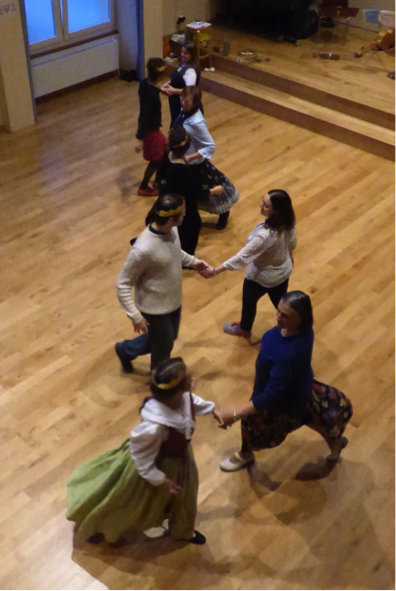
Tänze zu besonders schöner Musik des 16./17. Jh., von ruhig bis beschwingt, von einfach bis nobel, aber stets natürlich bewegt.
- Allemande "So ben mi chi ha bon tempo", einfache, fliessende Allemande (was es musikalisch auch typisch ist!) mit Varianten (nicht der Paartanz von C. Negri).
- Branle des Calmites (? - !): Branle des Hermites so angepasst, dass man zu dieser einfachen, zauberhaften Melodie arbeau-gemäss "mit gutem Gewissen" als Zeitgenosse innig tanzen kann!
- Dargason: die einzige mir bekannte Interpretation, die auch schön zum tanzen ist!! (Selbt Cecil Sharp hätte sich darüber gefreut ...)
- Pavane "L'amour de moy": ja das ist eine wunderschöne Pavane (auch wenn nicht als solche bezeichnet).
- Riu riu chiu: Darauf muss man einfach tanzen!
Dabei als hintergründig-tiefgründiges Thema: Wie kann die Bewegungsart der Renaissance für uns heutzutage wieder fruchtbar werden, bis in den Alltag hinein ☺.
Keine Vorkenntnisse nötig!
Musik live mit Fidel, Rebec, Flöten, Douçaine, Lautare und auch ab CD.
Sonntagskurs 10.15 – 17.00 (Pause 13h–14.30)
Altes Stadthaus, Winterthur, historischer Saal mit Holzboden, Marktgasse 53, nur 5 min. vom Bahnhof.
Fr. 75.- (inkl. Tanzbeschreibungen & Noten, Reduktion mögl.)
Tanzleitung, Anmeldung (nötig, sie wird bestätigt):
Andreas Rutschmann, Tel. 032 489 25 82
- Workshop
- Renaissance
- All levels
Stage estival 2019 de danse renaissance, baroque, flûtes, tambour "Favola...balla!"
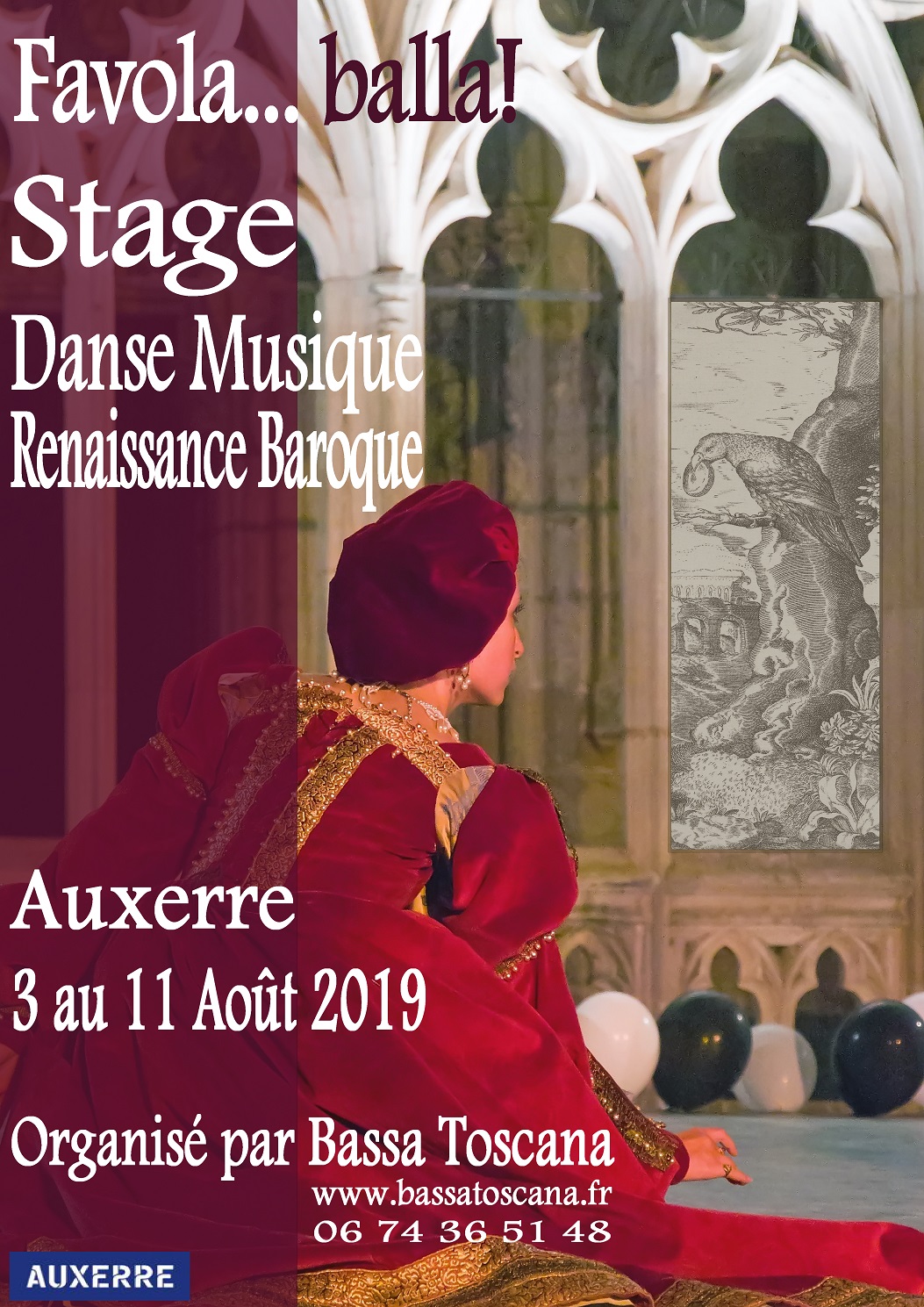
Production Bassa Toscana avec le soutien de la ville d’Auxerre
Bassa Toscana
23, rue des Grands Champs
Laborde
89000 Auxerre
Président:
Jean-François Méchain
Animateurs:
Renaissance Italienne
Bernadette Jacquet
Stéphane Quéant
Danse Baroque
Hubert Hazebroucq
Flûte et Tambour
Solène Riot
Renseignements
S. Quéant: 06 74 36 51 48
Studio de danse
Maison de la Danse,
9 rue Milliaux 89000 Auxerre
Bassa Toscana
La compagnie Bassa Toscana a été créée fin 2000. Elle a établi son siège à Auxerre, en Bourgogne, pour mettre en valeur le patrimoine et l’histoire de la région. Bassa Toscana fait le pari d’une offre culturelle originale, fondée à la fois sur les connaissances historiques et patrimoniales et sur la convocation du rêve et de l’imaginaire. Les costumes sont des reconstitutions de gravures des XVe et XVIe siècles. Quant aux danses, ce sont les traités de Négri, de Caroso et de Thoinot Arbeau, chanoine de Langres (« Orchésographie », 1588) qui ont permis de retrouver les chorégraphies de la Renaissance.
La compagnie Bourguignonne propose des créations, des conférences dansées, des stages et des ateliers pour enfants ou adultes qui mettent en valeur le lien fort entre le passé et le présent, entre le patrimoine et le monde actuel. A travers la découverte et la pratique de la danse Renaissance, Bassa Toscana a pour ambition de révéler la richesse d’un patrimoine français dans le but d’affermir la cohésion et le lien social autour des valeurs artistiques et historiques.
La rencontre avec Obsidienne et Compagnie permet aux chorégraphes de Bassa Toscana de participer aux créations de ce groupe musical (Ballades en balades, Fricassée de chansons, Le Jardin des Délices, Miracle, le Roman de Fauvel, le Livre Vermeil de Montserrat et Chantons sous la neige pour les fêtes de l’âne entre 2005 et 2017 ou encore, L’Amour de moy s’y est enclose, pour les festivals de musique ancienne de Nantes et du Haut Jura 2008).
Bassa Toscana a été engagée dans plusieurs projets au côté de La Fenice avec Jean Tubéry élargissant son répertoire à la danse Baroque.
La compagnie est également associée à d’autres ensembles musicaux tels que Perceval, Les Coccigrues, Les Hautbois d’Henry IV, La Bellezza, La Maurache, Joër… Elle a franchi les frontières de l’Allemagne avec les musiciens de l’Ensemble La Voilotte de Mannheim. La collaboration avec le conservatoire d’Auxerre a permis la création de nombreux spectacles, réunissant dans une même émotion scénique amateurs et professionnels.
La souplesse artistique et créative des chorégraphes confère à Bassa Toscana toute son originalité et toute sa faculté d’adaptation au thème de chaque spectacle. Le beau, l’émotion et l’humour contribuent toujours à l’élaboration des programmes, qu’ils soient purement narratifs ou allégoriques, ou simplement composés d’une suite de danses.
Renseignements
Danse
Tarif préférentiel pour une inscription avant le 31 mai 2019 360 €
Tarif de base pour une inscription après le 31 mai 2019 450 €
Tarif couple ou famille sur demande.
Musique
Tarif préférentiel pour une inscription avant le 31 mai 2019 320 €
Tarif de base pour une inscription après le 31 mai 2019 400 €
Nombre de places limitées
Acompte
Un acompte de 100 €uros à l’ordre de Bassa Toscana doit être envoyé avant le 31 mai 2019 pour le tarif préférentiel ou avant le 15 juillet 2019 pour le tarif de base avec la fiche d’inscription. L’acompte n’est pas remboursable en cas de désistement après le 15 juillet 2019.
Bulletin d’inscription à renvoyer avec le paiement à:
M. Chemin, trésorier de Bassa Toscana,
41, rue Pierre Semard
94120 Fontenay-sous-bois
Les frais de voyage, d’hébergement et les repas sont à la charge des stagiaires.
Une liste d’adresses peut vous être envoyée sur demande
- Workshop
- Summer School
- Ball
- Exhibition
- Course
- Renaissance
- Quattrocento
- Cinquecento
- French Renaissance
- Baroque
- Beginner
- Intermediates
- Advanced
- Professionals
- All levels
Stage de danse renaissance française et italienne
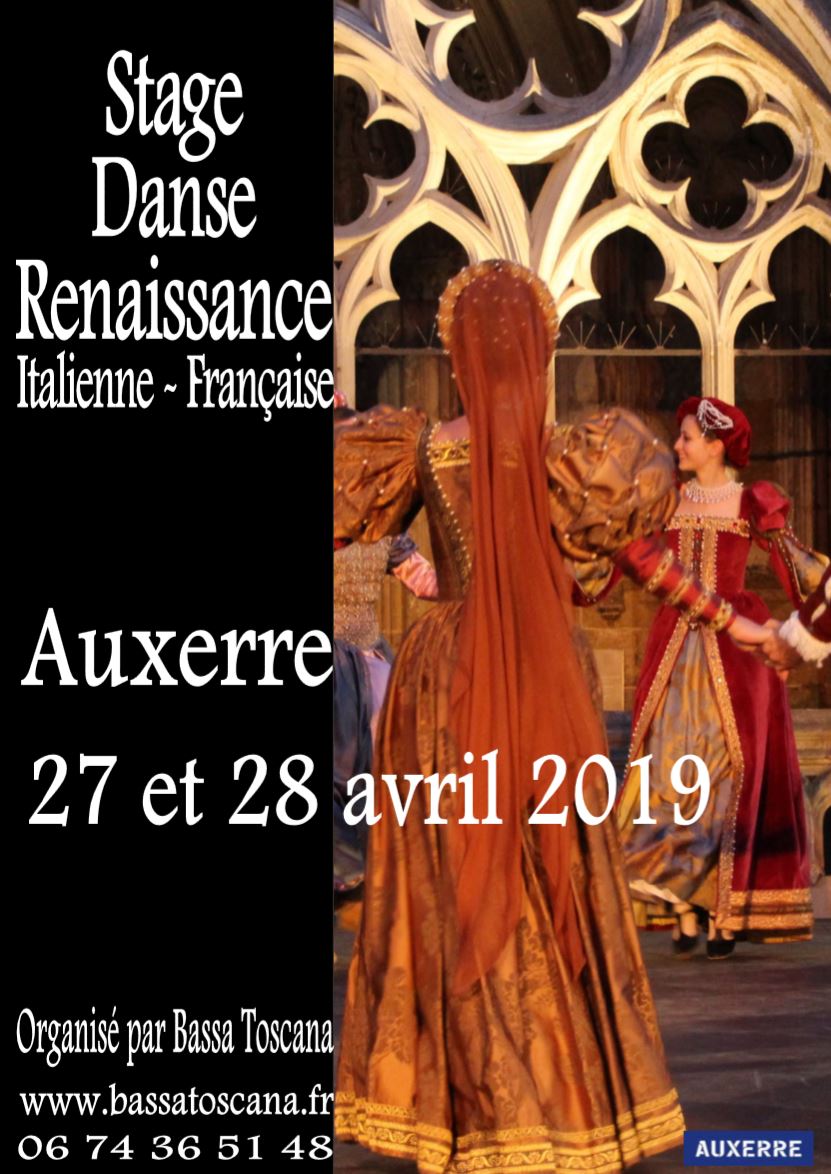
“ La danse est une espèce de réthorique muette, par laquelle l’orateur peut, par ses mouvements, sans parler un seul mot, se faire entendre et persuader les spectateurs qu’il est gaillard digne d’être loué, aymé et chéri… ” (Thoinot Arbeau, Orchésographie, Langres 1588 ). Du XVe siècle à la Renaissance, nous connaissons essentiellement la danse de cour. Bien danser, savoir chanter et jouer d’un instrument permettaient de tenir avec grâce et dignité son rang dans la société. La Renaissance en musique et en danse est caractérisée par l’introduction dans le registre courtois de formes et d’éléments populaires. C’est ainsi qu’une part importante est accordée aux rondes, facteur de convivialité et de cohésion sociale. Les traités du XVe siècle (Ebréo, Piacenza, manuscrit de Marguerite d’Autriche) et ceux du XVIe siècle (Negri, Caroso, Arbeau…) offrent les premières notations des pas et mouvements de danse. Deux formules répondront aux besoins des stagiaires, débutants ou initiés:
- Les bases de la danse de la Renaissance française seront enseignées à chacun des stages suivant le répertoire de Thoinot Arbeau, ( branle double, branle simple, branle coupé, branle morgué, branle gay, gavotte, pavane, gaillarde et volte...).
L’atelier chorégraphique s’attachera à l’étude du style et à l’expression esthétique des danses de la Renaissance italienne. La mise en espace du mouvement s’appuiera, soit sur des créations, soit sur des reconstitutions d’époque telles que: Basse danse Reale (Domenico), basse danse Cupido (Guglielmo), Leggiadra Marina, Lo Spagnoletto, Amor Costante Spagnoletta...
Production:
Bassa Toscana
23.rue des Grands Champs
Laborde
89000 Auxerre
Président:
Jean-François Méchain
Animateurs membres le la Fédération française PRO.D.A
Bernadette Jacquet
Stéphane Quéant
Lieu:
Maison de la danse
9, rue Milliaux
89000 Auxerre
Renseignements
Stéphane Quéant:
06 74 36 51 48
Renseignements
FORMULE 1 (initiation )
Horaires :
Samedi 14 h à 16 h
Dimanche 12 h à 14 h
Tarifs
1 après-midi : 27 €
2 après-midi : 38 €
FORMULE 2
( initiation + atelier chorégraphique )
Horaires :
Samedi 14 h à 18 h
Dimanche 12 h à 16 h
Tarifs :
1 après-midi : 38 €
2 après-midi : 46 €
Tarifs spécial couple:
Stage complet: 85 €
½ Stage: 70 €
ANNULATION :
L’association Bassa Toscana se réserve le droit d’annuler un stage, auquel cas les inscriptions reçues seraient intégralement remboursées. Les animateurs peuvent également intervenir sur le programme en fonction du niveau et du nombre de stagiaires.
- Workshop
- Renaissance
- Quattrocento
- Cinquecento
- French Renaissance
- Beginner
- Intermediates
- Advanced
- All levels